Well it's been the driest March for about 40 years for most parts of the UK. Already here we are in the 3rd week of April (2011 and there are stories in the news appearing about the water levels in our reservoirs.
The BBC has reported earlier this week that some of the reservoirs are currently at around 80% of the expected levels for this time of the year. But didn't we have a decent amount of rainfall over the winter (including the several bouts of snowfall)? So one dry month and the country seems to start running out of water.
Does this mean that we are in fact living beyond our means for water, especially with a drier climate predicted and an ever-increasing population?
This hightlights the need for a water strategy and one which embraces all available techniques, from water conservation right throught to localised capture/collection. Obviously we at Freerain are very focused on rainwater harvesting and we have seen from our own monitoring that a typical household can reduce their mains water demand by 50%. But also there is a need for education at various key levels to ensure that water is used carefully.
There has been some debate over the years surrounding the carbon cost of rainwater harvesting, but it must be stressed that a small amount of carbon is more than worthwhile to keep the taps flowing. Again, rainwater harvesting must be used together with various other techniques as part of an all round effort.
At Freerain we have recently launched a new range of UK manufactured rainwater harvesting tanks to further reduce the environmental impact of similar German imported tanks. These tanks can be used in domestic and smaller commercial applications. They start from 1,800 litres right through to 10,000 litres, all single piece and all have a very low profile. Being made from polyethylene and designed to be installed in very high water tables, they can be installed without concrete bases, backfills or surrounds. Domestic rainwater harvesting tanks
Tuesday, 12 April 2011

Tuesday, 3 August 2010
First a hose pipe ban and now canal issues
There is much talk in the industry regarding payback rates, carbon footprints and reliability issues with rainwater harvesting systems. Yet the real issue is the security of the national water supply. We have been far too relaxed over the last century, mainly thanks to the Victorian engineers, driven on by the industrial revolution. Also our perception that the UK climate is wet and therefore water is not a resource, it merely comes out of the tap anytime we turn it on. With an ever-increasing population, possible climate change, evidence is pointing towards more pressure on the most basic of resources.
In recent weeks we saw the start of the first water restrictions in the UK for four years and it was actually very surprising to see it not in the South East, but the North West. Whilst this is more of a pain than a real issue, it points to a potentially greater problem. A single dry season has been enough to stress the supply. Just this week we have seen further evidence of the environmental impact of an over-stressed water supply. As reported by the BBC there are closures of canal ways due to the lack of water, see here The Leeds-Liverpool canal is one of the major parts of the network. Not only does this imply the environmental concerns, but also the impact on tourism and the economic situation.
Also this week, people in the midlands are being asked to conserve water, to avoid a mandatory ban. See here, also from the BBC.
So when the issue of rainwater harvesting is being considered is simply not enough to consider it as a stand-alone solution for a single dwelling, project or even a larger site. Does it really matter that it might not payback in less than three years? Well certainly costs are important and nobody is suggesting otherwise, but maintaining supplies through the use of rainwater harvesting and other water conservation measures.
www.freerain.co.uk
In recent weeks we saw the start of the first water restrictions in the UK for four years and it was actually very surprising to see it not in the South East, but the North West. Whilst this is more of a pain than a real issue, it points to a potentially greater problem. A single dry season has been enough to stress the supply. Just this week we have seen further evidence of the environmental impact of an over-stressed water supply. As reported by the BBC there are closures of canal ways due to the lack of water, see here The Leeds-Liverpool canal is one of the major parts of the network. Not only does this imply the environmental concerns, but also the impact on tourism and the economic situation.
Also this week, people in the midlands are being asked to conserve water, to avoid a mandatory ban. See here, also from the BBC.
So when the issue of rainwater harvesting is being considered is simply not enough to consider it as a stand-alone solution for a single dwelling, project or even a larger site. Does it really matter that it might not payback in less than three years? Well certainly costs are important and nobody is suggesting otherwise, but maintaining supplies through the use of rainwater harvesting and other water conservation measures.
www.freerain.co.uk
Sunday, 27 June 2010
Hose pipe bans on the way
Water, water everywhere, but not a drop to spare....
No doubt you will have seen in the national press a story concerning the North West of England and the mounting concerns regarding water restrictions. It is very likely after a dry spring season, that hose-pipe bans and perhaps reduced water pressure could be in place shortly. Also, we have seen the warmest weekend of the year, following an above average temperature week.
For me this highlights the need to conserve our most basic of resources, what we are saying here is that, an above average rainfall region becomes water stressed, by one dry season. What is likely to mean, if the population growth figures are true and the affects of "global warming"?
Already at Freerain Ltd, we have seen a dramatic increase in enquiries from all areas of the UK and not just the North West. The gardening rainwater harvesing systems, Rain King, allow easier retro-fitting of a rainwater system, as they don't require changes to the internal plumbing arrangements.
No doubt you will have seen in the national press a story concerning the North West of England and the mounting concerns regarding water restrictions. It is very likely after a dry spring season, that hose-pipe bans and perhaps reduced water pressure could be in place shortly. Also, we have seen the warmest weekend of the year, following an above average temperature week.
For me this highlights the need to conserve our most basic of resources, what we are saying here is that, an above average rainfall region becomes water stressed, by one dry season. What is likely to mean, if the population growth figures are true and the affects of "global warming"?
Already at Freerain Ltd, we have seen a dramatic increase in enquiries from all areas of the UK and not just the North West. The gardening rainwater harvesing systems, Rain King, allow easier retro-fitting of a rainwater system, as they don't require changes to the internal plumbing arrangements.
Friday, 23 April 2010
UK Water Bills could rise
Background/Introduction
The most basic requirement in the UK, namely water is seriously under threat. Yet in this country we seem to be fairly blinkered into the carbon only argument in terms of our sustainable approach. Yes, carbon is a very important subject and measure of our environmental progress, but I would argue that it cannot and must be not used as the only measure.
With the UK's population set to increase by potentially 20 million more by 2050 and shifts in our climate (yet to be fully understood and determined), all resources will come under unprecedented stress. Added to this the current stress levels on water supplies in the South East of England, water conservation is a must.
Water of course is not only required for the most basic function, namely drinking, but it is fundamental to our crop growing and agricultural strategies. Recent studies have indicated that the availability of suitable growing conditions in the future maybe restricted to the wettest parts of the UK, i.e. Wales, Scotland and parts of the South West. Meaning that the traditional cereal regions, such as East Anglia and Lincolnshire would be lost from production. Yet more resource stress.
Planning
Strategic level planning for water is centered on the extra people and the dwindling (expected) rainfall predictions. So less water for more people. Currently in the UK we "enjoy" an average of 150 litres per person per day, more in certain areas of the country, the South East. The Code for Sustainable Homes (CSH) aims for a reduction to 80 litres per person per day at code level 5 and 6. For many this would be a complete change to their way of life. Potentially ending "taken-for-granted" activities, such as a full bath or nightly garden watering etc.
Rainwater harvesting - a solution
In the UK we have been fairly slow to adopt rainwater harvesting, this in part is due to the lack of financial incentives. In Germany, where rainwater harvesting is widely used, the cost of water is significantly higher than here in the UK. Lack of grants for rainwater harvesting, such as those enjoyed by other technologies, such as Solar, has made it difficult for business and individuals to justify the expense on paybacks alone.
Better technology, the recently published BS8515:2009, improved supply chains, installers and understanding will help to reduce the overall cost of installing a rainwater collection system.
However, a warning from the water companies suggests that the cost of water is moving up and one report recently in the Daily Mail suggests 27% above inflation.
http://www.dailymail.co.uk/news/article-1267821/Water-bills-soar-industry-unsustainable-firm-warns.html
The most basic requirement in the UK, namely water is seriously under threat. Yet in this country we seem to be fairly blinkered into the carbon only argument in terms of our sustainable approach. Yes, carbon is a very important subject and measure of our environmental progress, but I would argue that it cannot and must be not used as the only measure.
With the UK's population set to increase by potentially 20 million more by 2050 and shifts in our climate (yet to be fully understood and determined), all resources will come under unprecedented stress. Added to this the current stress levels on water supplies in the South East of England, water conservation is a must.
Water of course is not only required for the most basic function, namely drinking, but it is fundamental to our crop growing and agricultural strategies. Recent studies have indicated that the availability of suitable growing conditions in the future maybe restricted to the wettest parts of the UK, i.e. Wales, Scotland and parts of the South West. Meaning that the traditional cereal regions, such as East Anglia and Lincolnshire would be lost from production. Yet more resource stress.
Planning
Strategic level planning for water is centered on the extra people and the dwindling (expected) rainfall predictions. So less water for more people. Currently in the UK we "enjoy" an average of 150 litres per person per day, more in certain areas of the country, the South East. The Code for Sustainable Homes (CSH) aims for a reduction to 80 litres per person per day at code level 5 and 6. For many this would be a complete change to their way of life. Potentially ending "taken-for-granted" activities, such as a full bath or nightly garden watering etc.
Rainwater harvesting - a solution
In the UK we have been fairly slow to adopt rainwater harvesting, this in part is due to the lack of financial incentives. In Germany, where rainwater harvesting is widely used, the cost of water is significantly higher than here in the UK. Lack of grants for rainwater harvesting, such as those enjoyed by other technologies, such as Solar, has made it difficult for business and individuals to justify the expense on paybacks alone.
Better technology, the recently published BS8515:2009, improved supply chains, installers and understanding will help to reduce the overall cost of installing a rainwater collection system.
However, a warning from the water companies suggests that the cost of water is moving up and one report recently in the Daily Mail suggests 27% above inflation.
http://www.dailymail.co.uk/news/article-1267821/Water-bills-soar-industry-unsustainable-firm-warns.html
Tuesday, 26 January 2010
Housing Association opts for a communal rainwater harvesting system
Intro

Freerain Ltd has recently supplied a communal rainwater harvesting system to Two Rivers Housing Association at their Turley Court site in Cinderford, near Gloucester.
The system supplies ten dwellings with collected rainwater from the roofs to supply WC flushing and an outside tap.
The System
13,000 litre underground storage tank
Freerain DUO204 control set
2 submersible pumps for duty/assist
Full mains top-up
It is estimated that the system will provide 265M3 of water per year, providing a financial saving and helping to reduce the overal environmental impact of the site.
The site also has an extenive range of other environmental measures, which enabled it to reach the Code for Sustainable Homes Level required.
This site is of particular interest as due to the design of the houses a header tank system for rainwater harvesting control system wasn't possible. Normally where dwellings share a collection tank, each dwelling uses its own secondary tank.

Freerain Ltd has recently supplied a communal rainwater harvesting system to Two Rivers Housing Association at their Turley Court site in Cinderford, near Gloucester.
The system supplies ten dwellings with collected rainwater from the roofs to supply WC flushing and an outside tap.
The System
13,000 litre underground storage tank

Freerain DUO204 control set
2 submersible pumps for duty/assist
Full mains top-up
It is estimated that the system will provide 265M3 of water per year, providing a financial saving and helping to reduce the overal environmental impact of the site.
The site also has an extenive range of other environmental measures, which enabled it to reach the Code for Sustainable Homes Level required.
This site is of particular interest as due to the design of the houses a header tank system for rainwater harvesting control system wasn't possible. Normally where dwellings share a collection tank, each dwelling uses its own secondary tank.
Monday, 6 April 2009
Rivers may run dry
Recent press reports have again highlighted the pressures on national water-supplies and the consequences if steps are not taken now to reduce consumption.
All the main national newspapers have now carried articles outlining the likely effect on national rivers if water continues to be extracted at current rates; within a relatively short number of years substantially reduced summer flow-rates are predicted.
Alongside this scenario, the press have also been reporting that the fitting of water meters is to become mandatory. Water meters are shown to play a useful role in reducing mains water consumption, although some claim that this can have a unfair impact on the poor.
So far, articles such as the above have failed to draw the link between reducing national mains water consumption, and the widespread introduction of rainwater harvesting, which reduce domestic consumption by around 50% without any adverse social and environmental effects.
Use for commercial and industrial applications, this mains water saving can rise to in excess of 80% on any building that combines a large roof, with a high demand for non-potable for applications such as toilet flushing, clothes washing and outside use.
All the main national newspapers have now carried articles outlining the likely effect on national rivers if water continues to be extracted at current rates; within a relatively short number of years substantially reduced summer flow-rates are predicted.
Alongside this scenario, the press have also been reporting that the fitting of water meters is to become mandatory. Water meters are shown to play a useful role in reducing mains water consumption, although some claim that this can have a unfair impact on the poor.
So far, articles such as the above have failed to draw the link between reducing national mains water consumption, and the widespread introduction of rainwater harvesting, which reduce domestic consumption by around 50% without any adverse social and environmental effects.
Use for commercial and industrial applications, this mains water saving can rise to in excess of 80% on any building that combines a large roof, with a high demand for non-potable for applications such as toilet flushing, clothes washing and outside use.
Thursday, 26 February 2009
British Standard for Rainwater Harvesting Systems

The recent publication of British Standard 8515 for rainwater harvesting systems, available via http://www.bsigroup.com/, establishes for the first time a yardstick against which systems being supplied in the UK can be measured.
Harvesting rainwater to supply household needs is one of the oldest and most durable forms of supplying water worldwide, although until recently practiced in the UK mainly in the context of garden irrigation, following the introduction by the Victorians of mains-supplied water.
Due to modern lifestyles and population growth, however, UK mains water supplies are now coming under varying degrees of stress – particularly in England south of the Humber where the stress is generally severe (see Environment Agency map).
This is reflected in the mains water consumption requirements set out in the Code for Sustainable homes, and commercial equivalents such as BREEAM assessments. Up to a point, these requirements can be met by economising on water use, but if lifestyle (baths and showers etc) is not to be compromised then substituting recycled water for mains water becomes necessary.
The easiest and most cost-effective way of doing this is to use harvested rainwater instead of mains water for non-potable uses such as toilet-flushing, clothes washing machines, car washing and irrigation. This reduces mains water consumption by around 50% in the home and by more than 80% in any building that combines a large roof with a high demand for non-potable water.
BS 8515 now sets the standard for how systems as a whole (see schematic diagram) and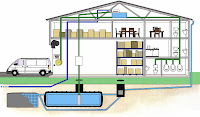 components within the system should function. Very simply, the aim is to route the rainwater falling on the roof to a storage tank, filtering it beforehand to remove any solid impurities. When needed, the water is then pumped (directly or via a header tank) to its point of use via pipework dedicated to non-potable water.
From the users perspective, using rainwater in this way is indistinguishable from using the normal mains supply, with the associated controls automatically controlling all functions and ensuring, using a mains water backup when needed during prolonged dry spell, continuity of supply.
Harvesting rainwater to supply household needs is one of the oldest and most durable forms of supplying water worldwide, although until recently practiced in the UK mainly in the context of garden irrigation, following the introduction by the Victorians of mains-supplied water.
Due to modern lifestyles and population growth, however, UK mains water supplies are now coming under varying degrees of stress – particularly in England south of the Humber where the stress is generally severe (see Environment Agency map).
This is reflected in the mains water consumption requirements set out in the Code for Sustainable homes, and commercial equivalents such as BREEAM assessments. Up to a point, these requirements can be met by economising on water use, but if lifestyle (baths and showers etc) is not to be compromised then substituting recycled water for mains water becomes necessary.
The easiest and most cost-effective way of doing this is to use harvested rainwater instead of mains water for non-potable uses such as toilet-flushing, clothes washing machines, car washing and irrigation. This reduces mains water consumption by around 50% in the home and by more than 80% in any building that combines a large roof with a high demand for non-potable water.
BS 8515 now sets the standard for how systems as a whole (see schematic diagram) and
 components within the system should function. Very simply, the aim is to route the rainwater falling on the roof to a storage tank, filtering it beforehand to remove any solid impurities. When needed, the water is then pumped (directly or via a header tank) to its point of use via pipework dedicated to non-potable water.
From the users perspective, using rainwater in this way is indistinguishable from using the normal mains supply, with the associated controls automatically controlling all functions and ensuring, using a mains water backup when needed during prolonged dry spell, continuity of supply.
Subscribe to:
Posts (Atom)
